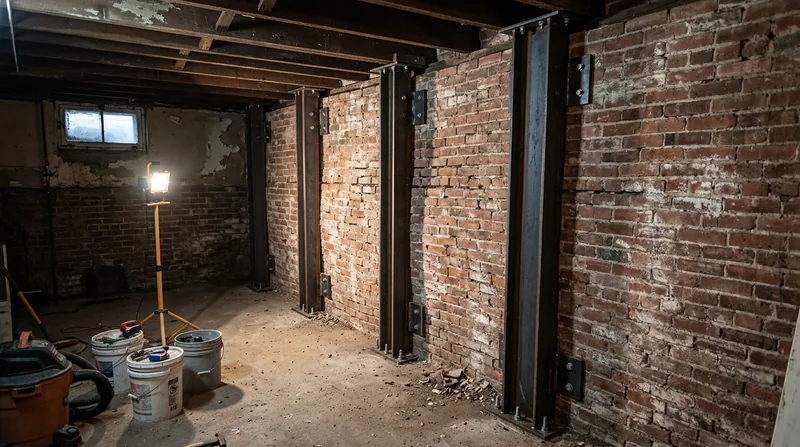




If you own an older home on the Central or East Hillside, or in Lincoln Park where the streets climb steeply from the lake, you already know what a hard winter does to a block foundation. The ground here is glacial clay and silt left by Glacial Lake Duluth, and it drains slowly. Snowmelt and summer downpours run down the hillside streets and push against basement walls until they lean. Bowing Wall Repair in Duluth is the work of stopping that movement with carbon fiber straps, steel I-beams, or wall anchors before the wall fails. We look at the wall, the soil, and the drainage together, because a leaning wall is almost always a water and pressure problem first. Call Duluth Waterproofing at (218) 520-4386 to get a free basement inspection and a straight answer on what the wall needs.
Why Bowing Walls Are Common in Duluth's Hillside Neighborhoods
Most of the bowing walls we see are in 1890s to 1930s houses with stone, brick, or early block foundations, and in the 1940s to 1960s ranches and split-levels in Woodland, Morgan Park, and Duluth Heights with block walls. The lake clay holds water against the wall, freeze-thaw cycles open the joints, and lake-effect snow piles against the foundation. Over enough winters, the wall bows inward.
- Hydrostatic pressure from saturated glacial clay pushes the middle of the wall inward.
- Freeze-thaw cycles open horizontal and stair-step cracks in old block and stone.
- Clogged or missing footing drains let water sit against the wall instead of draining away.
- Downspouts that discharge next to the foundation add water right where the wall is weakest.
- Efflorescence and horizontal cracking at mid-wall are early signs the wall is moving.
If you see any of these, get the wall looked at before the next spring melt. A wall that is still stable can often be stabilized; a wall that has moved several inches may need more.
Key info: On the lower streets of Lincoln Park and the East Hillside, we routinely find stone and early block walls that have been bowing for decades. The movement is slow, but it does not reverse on its own, and a wet spring speeds it up.
For official guidance on structural repair permits in Minnesota, check the City of Duluth building department before any structural work begins.
How We Diagnose and Repair a Bowing Wall in Duluth
We start by finding out how far the wall has moved and what is pushing it. That means measuring the bow, checking for horizontal cracking and efflorescence, and looking at the drainage on the outside. The repair method follows the severity, not the other way around. A wall that has moved a little gets stabilized; a wall with serious movement gets a structural solution matched to the pressure behind it.
- We inspect the wall inside and out, measure the bow, and note crack patterns and moisture.
- We check grading, downspout discharge, and the footing drain to see where the water is coming from.
- We recommend carbon fiber straps for minor to moderate bowing where the wall is still sound.
- We recommend steel I-beams or wall anchors where the movement is greater and the clay pressure is high.
- We correct the water source with drainage work so the repaired wall is not pushed again.
Stabilizing the wall without fixing the water is a temporary fix, and we say so up front. If the real problem is hydrostatic pressure, an interior drain tile system is often the better answer than exterior excavation, especially on hillside lots with limited access.
Key info: A split-level in Hermantown had a block wall bowing about an inch and a half after a wet spring. We installed carbon fiber straps and corrected the downspout discharge. Two winters later the wall had not moved further.
Repair Methods We Use and When Each One Fits
Not every bowing wall needs the same fix. The table below shows how we match the method to the movement and the pressure behind the wall. We explain the reasoning on site so you can see why one method fits your wall and another does not.
| Approach | Description | Best for |
|---|---|---|
| Carbon fiber straps | Straps bonded to the interior wall surface to stop further inward movement. | Minor to moderate bowing on sound block or poured walls. |
| Steel I-beams | Vertical steel beams anchored floor to joist to brace the wall. | Larger movement and high clay pressure on older walls. |
| Wall anchors | Anchors set in the soil outside pull the wall back toward plumb. | Walls that have moved and need to be pulled back, with yard access. |
| Drainage correction | Grading, downspout extensions, and drain tile to relieve pressure. | Any bowing wall where water is the driving force. |
In most Duluth cases we combine a structural method with drainage work, because the wall and the water are one problem.
Bowing Wall Repair Cost in Duluth: What to Expect
Bowing wall repair pricing starts at $600 for minor crack and movement stabilization, and rises with the length of the wall, the number of straps or beams, and whether drainage work is needed. A single wall with moderate bowing is one range; a full basement wall with anchors and drain tile is another. We give you a written scope before any work starts.
Getting two or three estimates is smart, and we encourage it. Ask each contractor what method they propose and why, and whether drainage is included. For a fuller breakdown of how we price work, see our pricing page.
Hiring a Bowing Wall Repair Contractor Near Me in Duluth
When you search for bowing wall repair near me in Duluth, you will get a mix of general foundation firms, plumbers, and waterproofing specialists. Ask each one whether they are licensed and insured, whether they carry general liability and workers compensation, and whether they will put the scope in writing. Ask for references from jobs in your neighborhood, and ask who pulls the permit if structural work is involved.
Permits are commonly required for structural foundation repair in Duluth, and the rules vary by jurisdiction, so verify with the local building department. A contractor who hesitates on that question is a contractor to skip. If you want to talk through your wall, contact us for a free inspection.
Bowing Wall Repair in Duluth: Pricing Guide
| Service | Price | Details |
|---|---|---|
| Crack and minor movement stabilization | Starting at $600 | Covers minor crack sealing and monitoring; wall length and number of cracks raise the price. |
| Carbon fiber strap installation | Starting at $1,200 | Straps bonded to the wall; price moves with wall length and strap count. |
| Steel I-beam bracing | Starting at $2,500 | Vertical beams anchored floor to joist; access and beam count drive the cost. |
| Wall anchor system | On estimate | Requires yard access and an on-site look at soil pressure and wall movement. |
| Travel | Included | In Duluth and surrounding areas, no separate call-out or mileage fee. |
| Estimate | Free | Response within 24h at (218) 520-4386, no obligation to book. |
Indicative pricing, the exact cost depends on square footage, finish, and site access. Free personalized estimate within 24h at (218) 520-4386.


